Tuesday, July 28, 2020
Horner Lilies: a local supplier of lilies and beauty
If you want lilies, the place to go in the London area is Horner Lilies on the edge of town near suburban Thorndale. Run by the Horner family, there are numerous gardens with more than a hundred different kinds of lilies.
I bought my lilies there and will be going back tomorrow to order some more. I'm taking my granddaughters and encouraging them to pick out a couple each that they can plan and we can all enjoy.
Customers wander the grounds, check out the blooms while noting note of the ones they like the best. On leaving, one orders the plants one wants and then picks up the bulbs ordered come fall.
Monday, July 27, 2020
Inspired by Sheila
I have an artist friend who loves to do paintings of flowers. She doesn't just paint the gorgeous blossoms in fully bloom but she tells the life story of blooms. Look carefully and you will find new buds, growing buds, opening buds, full blooms (often featured) and finally blooms with their petals withered, dead.
When shooting this picture of lilies, which were locally grown and sold by a man and his wife who specialize in growing gorgeous lilies, I included more than I would have if I had not been influenced by my friend and her storytelling approach to flower art.
Sunday, July 26, 2020
Capturing action easier today
Years ago I taught up-and-coming journalists how to shoot pictures. Originally the course used film cameras and all the technical stuff was important. With film one didn't know that one had missed the picture until hours after the fact. By the time the film was processed and an image pulled, it was too late for a reshoot in most cases.
Photographers, dependable shooters, were important back then and they were paid well for their talents and technical expertise. Today things are different.
The last time I taught a photo class, I think the group was very disappointed. I was given very little time to teach and so zeroed in on enthusiasm. Journalists no longer had to expend oodles of energy learning the photographic ropes before going out and capturing some damn fine images.
Cameras today, even relatively inexpensive ones like my old Fuji, are capable of grabbing good action when set to automatic. Point and shoot.
Today, where you point your camera is the big deciding factor. To be honest, photography was always about the image—where you pointed your camera—but the technical stuff all too often got in the way.
Today, you can have fun first and learn the technical stuff on the fly. I don't think the budding journalists were impressed. When it came to taking pictures, they did not want to be told to think.
I used to call reporters who took pictures "reluctant." They saw themselves as story tellers and they told their stories with words not with pictures. I wonder if this is changing as newsrooms shrink and staff numbers tighten.
Photographers, dependable shooters, were important back then and they were paid well for their talents and technical expertise. Today things are different.
The last time I taught a photo class, I think the group was very disappointed. I was given very little time to teach and so zeroed in on enthusiasm. Journalists no longer had to expend oodles of energy learning the photographic ropes before going out and capturing some damn fine images.
Cameras today, even relatively inexpensive ones like my old Fuji, are capable of grabbing good action when set to automatic. Point and shoot.
Today, where you point your camera is the big deciding factor. To be honest, photography was always about the image—where you pointed your camera—but the technical stuff all too often got in the way.
Today, you can have fun first and learn the technical stuff on the fly. I don't think the budding journalists were impressed. When it came to taking pictures, they did not want to be told to think.
I used to call reporters who took pictures "reluctant." They saw themselves as story tellers and they told their stories with words not with pictures. I wonder if this is changing as newsrooms shrink and staff numbers tighten.
Saturday, July 25, 2020
And it's all safer than the traditional play equipment
Traditional playground equipment, such as a swing with a seat made with a heavy, steel-capped wooden plank, is out. Adventure playgrounds pushed the swings, tall slides and simple teeter-totters into the retirement. But then, the injuries mounted and adventure playgrounds were phased out. Totally safe equipment then came into vogue. Boring. And so today, designers are taking another crack at coming up with the ultimate playground equipment.
I have to admit to having had reservations about a lot of the new stuff filling London parks. But, the more I travel about the city with my granddaughters, the more enthused I am getting. I'll have to go back to last night's park for pictures. It had the weirdest take on a slide ever. It was the reason my granddaughters took me there.
And the equipment comes from all over the world. So far, I've noted stuff from Big Toys of Chattanooga, Tennessee and HAGS of the U.K.
Friday, July 24, 2020
Big Toys: That's the company name and product
Some of the new playground equipment in London is quite imaginative. Now that the playgrounds are open around the city, my granddaughters and I are touring the burg looking for unique installations. The playground pictured features equipment from Big Toys of Chattanooga, Tennessee.
My granddaughters are playing on the Rock 'n Cross, a combination of a multi-rider teeter-totter with a dynamic overhead challenge. Hey, that's the company's description, not mine. I asked my youngest granddaughter how she liked it. "Not too much," she said. She found it a little frightening. The older girl was more positive. The big, high loop with equally-spaced handholds is one of the few monkey bar type installations she can still use. At ten, she now finds her feet drag on the ground most of the time. She also agreed with the company that the movement added an extra challenge.
I cannot help but wonder, what does a piece of equipment like this cost the city? And how long will it last? And are replacement parts easily available? Are the parts expensive? I noticed plastic collars on some of the equipment had grown brittle with time and cracked and chipped.
I'd like to see some research on these types of fancy playground "toys." I'm not convinced that some of these things are worth the cost. The city might be able to buy more equipment and keep more kids occupied if they went with equipment that was a lot less complex.
Thursday, July 23, 2020
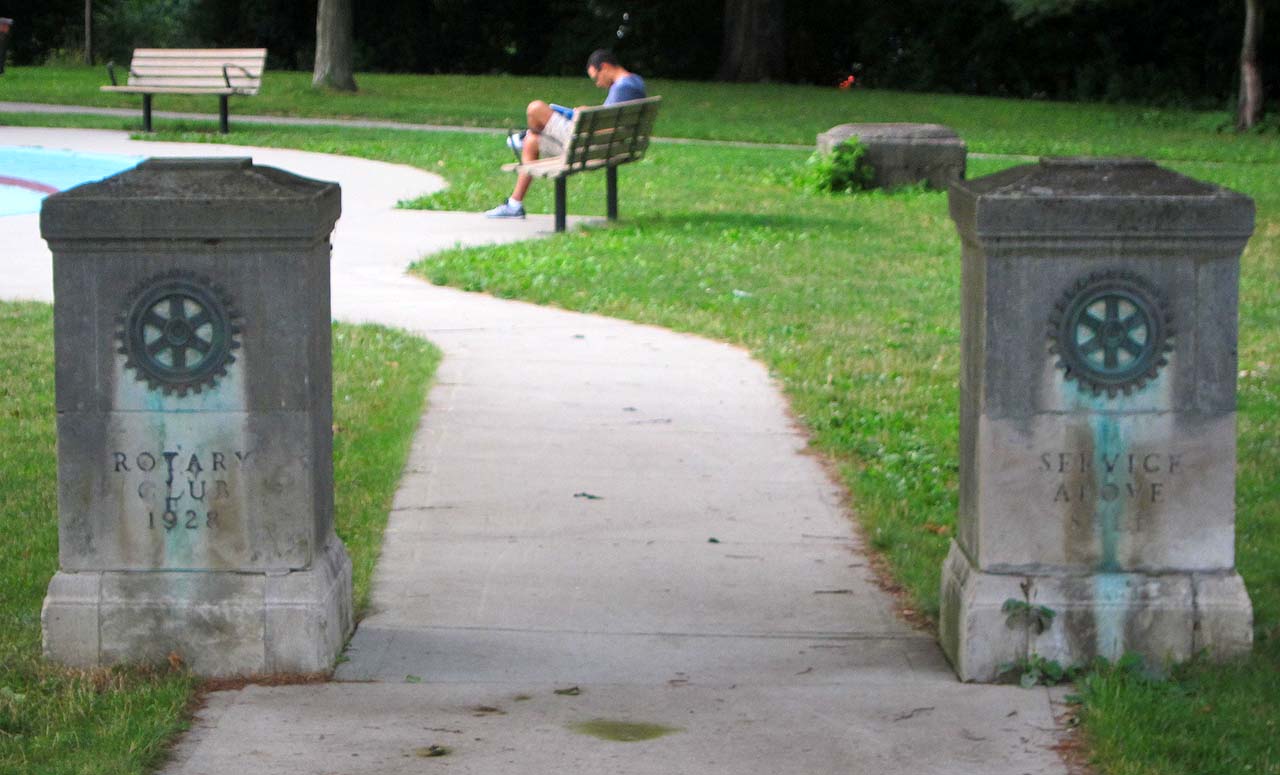
The wading pool has a long history. Surprising!
The short, twin pillars framing the sidewalk bear a clue to their origin. The one on the left says, "Rotary Club 1928." The one on the right reads "Service Above Self." But why were these placed in this location in Springbank Park some 90 or so years ago? The answer is right there before one's eyes.
The Rotary Club of London donated the funds to build the original Springbank Wading Pool in 1928. Who'd have known the little pool had such a history?
Wednesday, July 22, 2020
The urban texture is richer today
When I was a boy a lot of the urban landscape was better. For instance, it was easier to get around town, around the county and around the province without a car. We had buses and trolleys in the city, for outside town we had intercity buses and we had frequent passenger trains run by not one but two railroads.
But when it came to food, the old urban landscape of the late '40s and early '50s was pretty dull. If we got a crusty loaf of white, enriched bread from the bakery, we had something special.
Today my city and my province is no longer as dull. We have oodles of different ethnic groups and with their arrival came new, interesting foods The other night I made my wife a rice and vegetable dish spiced with harissa. My granddaughters call harissa the North African curry.
And the breads that are available today puts a big smile on my face. I've been known to go to the store for some lettuce and come home with five loaves of bread—all different. Today I resisted. I brought home just one extra load: an olive and parmesan focaccia loaf.
Focaccia is a flat, oven-baked, Italian bread similar in style and texture to pizza dough. Focaccia can be served with meals or, and this is one is a favourite, it can be used to make wonderful sandwiches.
There's more to cities than bricks and mortar. There are the residents of the city. And a rich mix of residents makes for a richer, more diverse, more interesting and exciting place to live.
Subscribe to:
Comments (Atom)