Sunday, April 21, 2013

Cardinals return to southwestern Ontario


It has been a colder and wetter spring than normal but that hasn't stopped birds, like the bright red cardinals, from returning to southwestern Ontario. The nice thing about a spring like this year's is that the buds on the fruit trees are not seduced by warm weather into bursting into flower too early. Last year was a warm spring and the almost inevitable late frost killed the blossoms, just about destroying the fruit crop.

Friday, April 19, 2013

Even mini urban cores losing businesses

The TD Canada Trust in downtown Lambeth has closed.

Some years ago, Lambeth was a separate little town on the south edge of London. It liked to be known as "Lovely Lambeth." Well, the little place isn't quite so little anymore, nor is it as lovely, nor is it an independent little town. It has been annexed into the expanding London urban monolith.

Within walking distance of many Lambeth homes, it still closed.
London's downtown is suffering. And the former commercial core of Lambeth is also suffering, and for some of the same reasons: For example, competition from suburban development is killing the old main street businesses.

London lost a number of its bank branches in the core. As businesses left, I imagine a lot of the commercial business also left.

Driving through Lambeth I noticed that one of the few banks in the town core has closed. It has moved to a suburban outdoor mall a couple of kilometres away.

I wonder what a dying downtown in a real small town says about the new urbanism theories? The Lambeth downtown is located in the middle of an older, grid patterned neighbourhood. The TD Canada Trust bank that has closed was within a short walk of lots of homes, and it had adequate parking at the side. Yet, it closed.


The new bank has a drive-thru but is more than two kilometres distant.

Wednesday, April 10, 2013

The new Sarnia Rd. Bridge


Yesterday I posted a view from the new Sarnia Rd. bridge. Until recently an heritage bridge built around 1890 in St. James, Manitoba, and relocated to London in 1909, was the span carrying traffic across the CP railway in northwest London.

The new bridge is clean and modern.
The old truss bridge was removed and put into storage, a move heritage groups supported. Pin-connected truss bridges are exceedingly rare in Ontario, yet London has one in storage and another in use — the restored King St. pedestrian bridge in the city core.

If you'd like to know more about the old, single lane iron bridge that until recently spanned the rail line, click on the link, "old truss bridge", above.

Today the crossing is so wide, the approach so long and gently curved, one hardly notices that one is on a bridge crossing the tracks. I miss the old bridge but with all the subdivisions being built in the area, the old bridge had to go.

Tuesday, April 9, 2013

CP rail line in northwest London


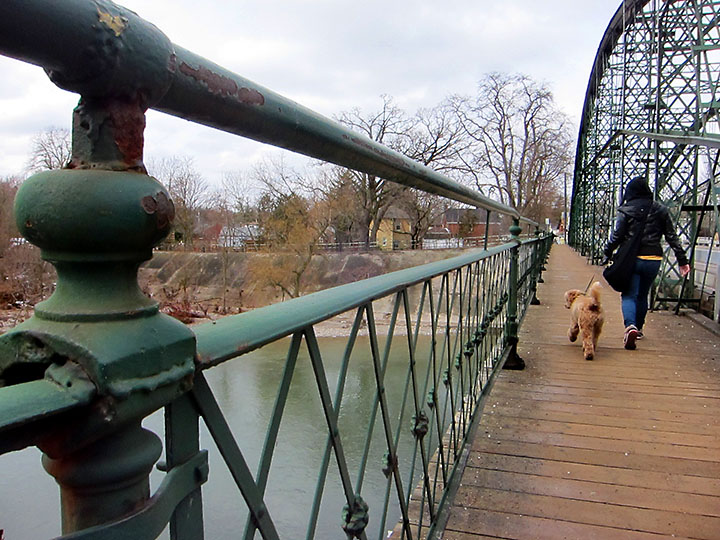
It looks quiet now, but this lone track carries rail traffic 24-hours a day. This is the Canada Pacific  main line in northwest London. Note the arc of an interesting wooden bridge spanning the tracks in the distance.

Monday, April 8, 2013

Heritage gas station has a new life


This heritage gas station on Main Street in Lambeth has seen a number of uses since it ceased pumping gas. Today it is the Jubilee Kafe — a cafe serving gluten free foods.

Stations like this were once common but most have been demolished. This one keeps being reborn but one must wonder how long until it too is history.

Lambeth was once a separate small town but was annexed an is now a part of London.

Sunday, March 31, 2013

Time to remove the snow tires.


Londoners are yearning for spring and eager to leave winter behind. The temp hits 10 degrees Centigrade Saturday and the walking trail at Springbank Park was packed. Folks were walking, jogging, cycling and skate boarding along the wide, paved roadway. And not only was the pathway crowded. The playground was filled, the swings and slides all in use.

It is time to remove the snow tires.

Saturday, March 30, 2013

A palace worthy of the Roman Catholic Bishops


When I moved to London, I lived in an area once known as Petersville. It was a suburb of London built on the low lying land across the Thames River from London proper.

When I went for a walk about the neighbourhood I would cross the North Branch of the Thames River at the Blackfriars Bridge. Above the large wrought iron span, overlooking the Petersville and Blackfriars neighbourhoods, there was a large and somewhat rundown looking white home with massive columns gracing the front.

I have since learned that the magnificent home was designed by a local architect, William Robinson, and it originally presented a less grandiose appearance. The massive columns were added before the home was donated to the Roman Catholic Church to be used as the new Bishop's Residence.

Reportedly, the donor, John Donally of Buffalo, New York, didn't find the original Italianate look regal enough for the bishops of London.

Today, thanks to some creative thinking, the old home has been converted into four condominiums and the structure may be around for many years to come.

Friday, March 29, 2013

Spring!

The blur in the image is caused by shooting through the kitchen window.

Robins, cardinals, mourning doves: they have all returned. This afternoon my wife and I saw our first chipmunk. I don't think there can be any argument. Despite the snow that still dots the city, I think it's safe to say, "Spring is here!"

Tuesday, March 26, 2013

Blackfriars Bridge: Hasn't it earned its retirement?

Pedestrian walkway is original, the second railing is a modification.

It's time to put the Blackfriars Bridge out of its misery — and make no mistake about it, the beautiful, heritage structure is suffering. The passing years, 137 to be exact, have taken their toll.

Decorative caps are missing from fasteners on the walkway barrier, original iron bracing is bent and distorted, the structure has been modified for pedestrian safety and overall bridge integrity.

Some decorative caps covering fasteners are missing.
London's Blackfriars Bridge is a bowstring through-truss bridge built in 1875 by the Wrought Iron Bridge Company (WIBC) of Canton, Ohio. With a main span of 225 feet, the bridge in London can brag it sports the longest span of any remaining bowstring truss bridge in North America.

Bowstrings are among the rarest types of truss bridges today but they enjoyed a brief period of popularity from about 1855 into the 1880s.

During that period, thousands of wrought iron bowstring truss bridges were produced by numerous American bridge builders but two Ohio-based manufacturers stand out: WIBC of Canton and King Iron Bridge, King Manufacturing Company, Cleveland. The bowstring was the most commonly erected all-metal bridge of the 1870s and both Ohio companies sold their own patented bowstring designs.

In 1875 not one but two WIBC designed and fabricated bridges were erected over the Thames River in London, Ontario: The Blackfriars Bridge and a sister bridge, the Victoria, at the southern end of Ridout Street. The Victoria was replaced in 1926.

Replacement support for upper handrail is a serious mismatch.
Both bridges were manufactured in Ohio and transported by rail to London. These were the first metal bridges to be erected in London.

Using some 9000 lbs. of wrought iron and cast iron, a bridge like the Blackfriars gives a whole new meaning to the warning "some assembly required." Often the factory sent along an engineer to assist with construction.

Contrary to local folklore, the London bridge is not the only wrought iron bowstring truss bridge still carrying vehicular traffic in North America. There are at least six others but not one carries the amount of daily traffic endured by the hard-working London span.

I believe asking a century old, and then some, bridge to carry 4000 vehicles a day 365 days a year is foolish. Think of the damage that winter road-salt alone inflicts on this treasure. And make no mistake, the London bridge is a treasure. The Boner Road Bridge in Indiana, built in 1869, has been completely restored. Yet, it is only asked to carry limited traffic.


Boner Bridge, a three span bowstring truss, has been completely restored.

And the Boner Bridge is not the only bowstring that has been lovingly restored. There are others but with one big difference: Most were restored and then retired to a future of pedestrian traffic only. I know of 20 bowstring truss bridges that have been re-purposed for pedestrian/cyclist use only.

Restored Rodrick Bridger relocated to university campus.
The Rodrick Bridge, built in 1872, was removed from its original location over Wills Creek, Coshocton County, to be restored and relocated in 1998 to Ohio State University-Newark Campus where it has been re-purposed for pedestrians and cyclists.

One of my favourite stories is the one surrounding the Old Richardsville Road Bridge in Kentucky. The old road, and thus the bridge, receives only limited use. Why: There is a new Richardsville Road.

Old Richardsville Rd. Bridge still carries vehicular traffic.
A gentleman living on the old road, David Gavin, assumed the upkeep of the beautiful, neighbourhood bridge. He has spent $175,000 of his own money replacing the deck with treated pine and replacing deteriorating iron rivets. A three span bridge made in 1889 by the King company, it's a beauty. David Gavin can take a well-earned bow.

The Blackfriars Bridge, with its 225-foot clear span, eliminated the intermediate supports required by the previous wooden bridges. In theory, the river-spanning length minimized the risk of a wash out caused by spring floods. It was a good theory; The Blackfriars Bridge is entering its 139th year of service.

It's time to find our beautiful, heritage bridge a new home. At the very least, let's move it a few feet up or down river — which ever makes the most sense. Let's restore our wrought iron work of art and craft. Let's give our now-rare-beauty another century or more of life.

Remember the five Rs:

  1. Remove it
  2. Restore it
  3. Relocate it
  4. Re-purpose it
  5. Reuse it

Remove it, restore it and reserve it for walkers and cyclists only.

Below

The first three pictures (below) show the wooden bridges that once served the area. Note the mid river supports required by all the wooden structures.The last picture is an early image of the Blackfriars Bridge still in use today.

Note the in-river supports required by the wooden bridges at this location.

Ivey Family London Room, London Public Library, London, Ontario, Canada

Tuesday, March 19, 2013

Another photo from The Tree of Light

Here is another shot from The Tree of Light show. I wonder if the city could put the show on again in the summer when the warmer weather would encourage more folk to come downtown for the viewing.

Of course, the figure skating theme might be one strike against a summer showing.   :-(


Monday, March 18, 2013

They call it 3D projection mapping; I call it cool.


The show was called The Tree of Light and it was part of the City of London's celebration of the 2013 World Figure Skating Championships. The skating competition was held inside the city's Budweiser Gardens arena and the high-tech light show was held on the outside of the arena. Both were steeped in the wow-factor.

The neatest illusion of the light show was the "unwrapping of the arena." That was just so cool. But there were lots of other bits of absolutely gorgeous eye-candy. No surprise here as the show was done by the well-known Canadian company specializing in these shows called the Moment Factory out of Montreal, Quebec.

There has been a lot of controversy about the championships and whether or not hosting them was worth it. But, the argument is based on a false dichotomy. Hosting these events is not question of profit vs. loss.

These events rarely return big bucks to the host communities. What they do do is put a town under a stress test. Can the community be trusted to host a big, complicated event and pull it off smoothly, professionally, without a hitch? This is the feather-in-the-cap award and London walked away a winner.

The Budweiser Gardens arena is a fine arena. And it is run very professionally. It has been said to be among the top fifty entertainment complexes of its type in the world. The smooth delivery of support for the figure skating event certainly lends credence to that reputation.

Some days I am proud to say I'm from London.


Saturday, March 16, 2013

London's jet d'eau in winter


The Walter J. Blackburn Memorial Fountain at the forks of the Thames shoots recycled river water from seven stainless steel jets daily from 7 a.m. to 11 p.m. winter and summer. Financed by a $450,000 donation from the Blackburn estate, the fountain was the realization of a decades-old dream of the late Walter and Marjorie Blackburn. It may be inspired by the 'jet d'eau' in Geneva, Switzerland, but the London fountain is not a copy of the Swiss one. Google the Geneva jet d'eau and you will appreciate the fine design of the London installation.

Sunday, March 10, 2013

Spring is in the air


The temperature hit 14-degrees Centigrade today in London, Ontario. Nice. The snow is melting, the roads are bare and folk can be seen walking everywhere throughout my neighbourhood.

You might notice in the above picture that people walk both on the sidewalk and on the street. A modern suburb, the streets are laid out in crescents and courts, with a few long, meandering roads servicing all. The heavy traffic is on the long, meandering roads. The remainder, the feeder streets are relatively quiet. For that reason, people often ignore the sidewalks.

I have touched on this in the past, but I'm going to flog this one more time. Suburban neighbourhoods like mine are walkable places. It is often a myth that downtown cores are more walkable places to live than the suburbs.

In fact, if you think about it, many downtown cores are horrible places to walk. Few stores to walk to but a gauntlet of street beggers that must be run.